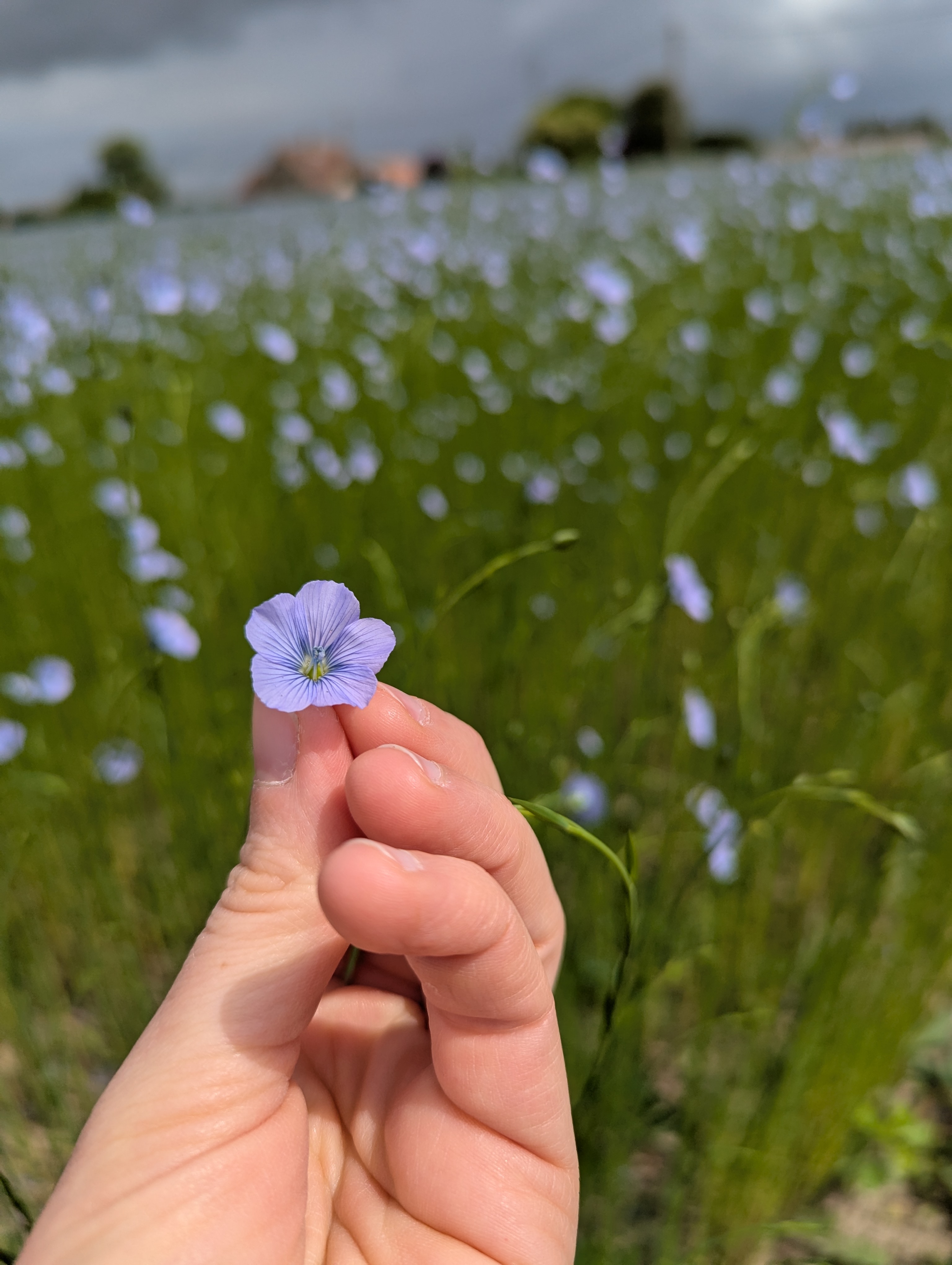

Excerpts from Laura’s travel notes in the flax-growing region of Belgium
In June 2025, I went to the world’s center of linen production, Kortrijk, Vlaanderen (Flanders), Belgium. I saw flax fields, toured a linen weaving mill, and visited the flax museum there.
After my visits, I am in possession of new facts. I am more in love with linen – as a fiber, as a process – than ever. I would recommend that anyone interested in fiber production or fiber arts who is nearby go visit too.
Here’s my disclaimer: I see signs that linen and hemp are beginning to have their merino wool moment – where everyone realizes that these are technical fibers. But, as with every fiber, linen needs to be understood well before we can unlock its technical capacity in a product design.
Important facts about linen:
- Flax-derived fibers are abrasion resistant, strong, and dissipate vibration in composites.
- We know that linen yarn and fabric quality is dependent on whether the fiber is line or tow, and that people around the world say that line quality is dropping over time for a variety of reasons, including climate change.
I know these facts because I’ve been paying attention to this space for a year now, participating in the North American Linen Association, and collaborating with Fantasy Fibremill.
People in these groups and all the flax researchers, growers, processors, spinners, and weavers have a wealth of hands-on knowledge that isn’t so easily translated as textual bullet points. Some of it becomes apparent only through hands-on experience and long conversations. So I’ve been prioritizing seeing the flax/linen supply chain in person whenever I can, in order to keep refining my understanding of how best to work with flax fiber to achieve incredible technical outcomes.
What I saw in Vlaanderen:
Fields, some budding, some flowering, some at seed
- Flax flower only blooms for a day


- Fields rotate – different every year, the flax museum (link below) keeps track of which are planted each year and can point you to where
- Cracking, raw soil visible was between plants. What maintains the topsoil?
- Plenty of bugs and a variety of weeds – seems like insecticide and weedkillers likely not used, as advertised
- The fields are mesmerizing in the wind, lots of bees on the flowers


- The fact that one field can be setting seed next to another with only flower buds seems to offset the shortness of individual flower availability to pollinators. Belgium’s weather constantly changes, too, so those bees gotta work hard during their brief windows of opportunity (was just 20 minutes between rains during part of my field visits)


Linen weaving mill

- Extremely friendly and open, generous with their time
- They go from bobbin to mercerized/sanforized bolt of cloth, dyeing / printing and other finishes outsourced
- mercerization for finer, sanforization for heavier-weight cloth
- Majority is 100% linen, but they also process some blends. Weaving linen is a specialized trade
- They have quite a robust testing lab
- Finer fabric is woven denser by beating harder
- So much dust on the weaving floor that there are robotic vacuums
- Invested in / constantly improving the training of the weaving technicians
- Seems like a few technicians per several machines, not just on the weaving floor; warehouse also highly automated
- All the processing rooms are maintained at a consistent temp and humidity range that is optimum for the linen
- Highly robotic, even setting up the warp beams through the reeds is done with a machine (I’ve seen even similar and larger volume weaving mills do this by hand). They were setting up a brand new machine during the tour
- Their machines are top of the line – old machines are sold back to the manufacturer, and then presumably to other, less demanding (or less wealthy) mills
- They have a HUGE library – every fabric they’ve ever made. This is an incredible trove, every designer’s dream
- They employ people to grade and inspect the finished cloth, the people even reweave some defects. We discussed AI defect tracking and the thought was – yes, eventually, but right now people are still better at defect detection on wovens


Museum
https://www.texturekortrijk.be/
- Every kind of composite object has been made from flax. Even a cello, which surprised me, since I thought the vaunted vibration-dampening effects of linen in composite would make that a poor choice for an instrument body… but I guess it should vibrate only enough.
- Beautiful building and displays
- Downstairs focuses on general introduction to flax and new research. Upstairs has history and historical machines
- Though, historically, growing and retting the flax seemed to be the industrialized core of the Flanders region, there seemed to be very little presentation space dedicated to retting


Takeaways:
- Flax and linen is arresting and inspiring, and a surprisingly transparent supply chain, in some ways. Its just not accessible – very geographically limited and concentrated in relatively few enterprises.
- I still don’t know many key things. More on this below…
What I don’t know yet:
- Is linen knittable? If yes, then does that only apply to long-line fibers or to tow, or both?
- What does an industrial wet spinning line look like? why did these lines and the scutching/heckling lines move away from the places that still grow and then weave flax?
- Why does no one talk much about retting? Why was it originally done in rivers but now only done in fields? Does the location matter? If it can be done in a river, why don’t we do this in industrial vats with controlled water and bacteria, like brewing or making biochemicals?
- What we can optimize or pay more for, during growing and processing, to get super long-line fiber, nor which applications definitely need this level of yarn? Once understood, I’m excited about how the Fantasy Fibremill local-for-local model could include spinning very specialized batches of yarn based on fiber length.
- How did people make extremely fine, even-textured linen handkerchiefs, before cotton was widely imported to Europe? Because vintage and antique examples of linen nearly look and feel like a completely different fabric from today’s linen.
- Are slubs and lower picks-per-inch truly always a characteristic of linen cloth? how dense a gabardine, say, could be woven?
- How does tow compare to line fiber in strength and abrasion resistance? in bending stiffness?
- How does retting and other processing affect these properties?
- What minimum quality of fiber is necessary for shoe uppers to meet abrasion resistance requirements? How would a linen upper perform at the bending break point at the ball of foot joint?
As the flax harvest comes in and my NALA membership renews for the year, I’m looking forward to answering these questions in the remainder of 2025 and in 2026!
